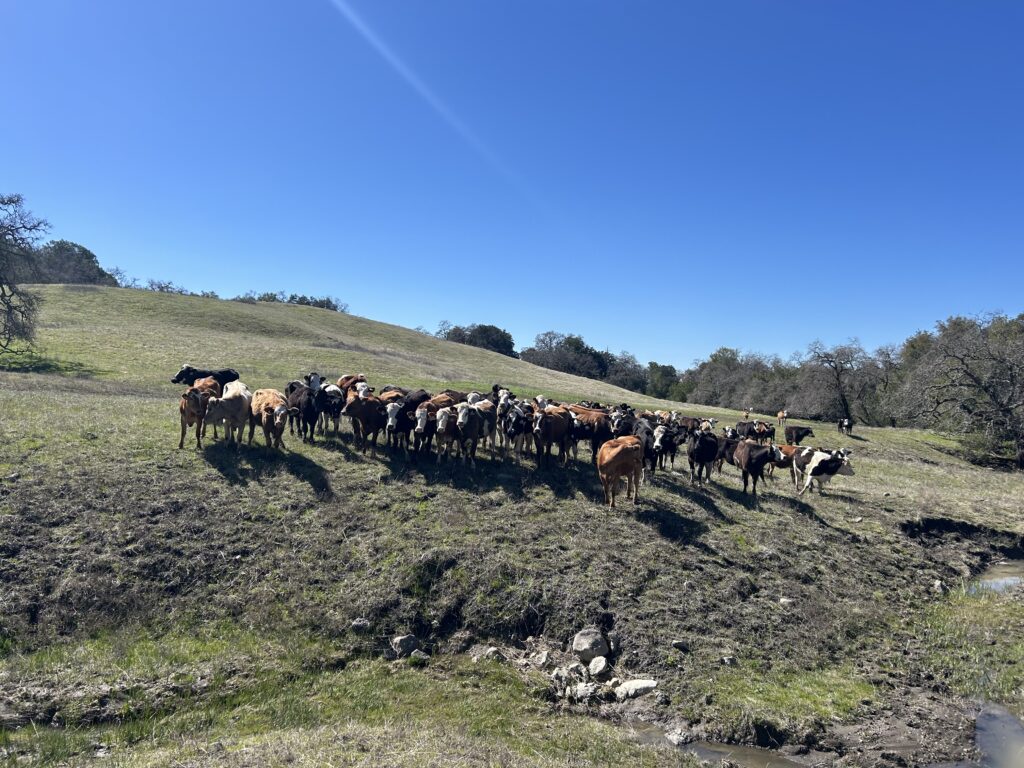
The primary goal of the Mitsui Ranch Preserve is researching ways of improving and revitalizing ecosystem function such as soil formation, soil water holding capacity, filtration of pollutants by groundwater, nutrient cycling, and recovery from historical disturbances. Since the arrival of Europeans more than 200 years ago, California’s grasslands have undergone a complete phase change, from a landscape dominated by perennial bunchgrasses, to one dominated by introduced annual grasses. Perennial grasses are much better at providing the ecosystem services described above, but they don’t compete well with the alien annual grasses brought here by European settlers. On the Mitsui Ranch Preserve we set out to re-establish a perennial grass-dominated rangeland. We use three major tools to achieve that goal: cattle grazing; prescribed fire; and re-establishing native perennial grasses by planting seeds after implementing prescribed fire.
In collaboration with Andrew Rayburn, Ph.D. (The Nature Conservancy), we surveyed much of the ranch property and compiled a list of native perennial grasses that are still present. Once we established what we had versus what we wanted, we began to plan how to achieve our goals. We found that very few native perennial grasses remain in the open pastures, and that just a few species of introduced annual grasses dominate them. Many alien annual grasses are poor quality forage species for cattle. Thus, we decided to use differences in life history strategies between perennial and annual grasses to give an advantage to perennial grasses.
Annual grasses invest most of their energy into producing a massive annual seed crop but devote very little energy in developing root systems. The shallow roots are what cause the annual brown-up of California’s rangelands in late spring: when seasonal rains stop and soil moisture recedes into the depths, annual grasses die. In contrast, perennial grasses invest heavily in their root systems. The height of the growing plant on the surface often has a root system that measures the same distance, or more, into the soil below…almost a mirror image. This life history difference between the two plant types results in a difference in vulnerability to fire. Perennial grasses recover from fire easily because they can start new growth from energy and water stored in their extensive root systems. Annual plants do not recover but depend on energy invested in the seeds that have dropped to soil; most of those seeds will survive on the soil surface and sprout when winter rains return. However, if a fire occurs at a time when the seeds are still on the standing plant, fire will kill them and drastically reduce the annual grasses in a pasture.
We enlisted the aid of FireForward, with support from CalFire and several local fire departments, to help us burn off selected pastures. We time prescribed fire for when the annual grasses are almost dead but still hold most of their seeds on their stalks. Our primary target is an alien annual grass called medusa head, but fire works well on other annuals as well. Medusahead is a species that cattle will not eat. Therefore, it continues to grow unabated until it takes over vast portions of pasture, leaving little food for cattle. Timed well, a prescribed fire can kill up to 95% of the annual seed crop of medusahead.

After prescribed fire, we use a no-till seed drill (Truax) to plant the burned area with native grass seed hand-collected here on the Mitsui Ranch Preserve and grown out and amplified for us by Heritage Growers. Heritage Growers are able, in a period of a few years, to take a small collection of seed and turn it into a harvest large enough for us to seed tens of acres. In fact, we gauge the acreage of our prescribed fire to be sure we have enough to replant in the desired areas.
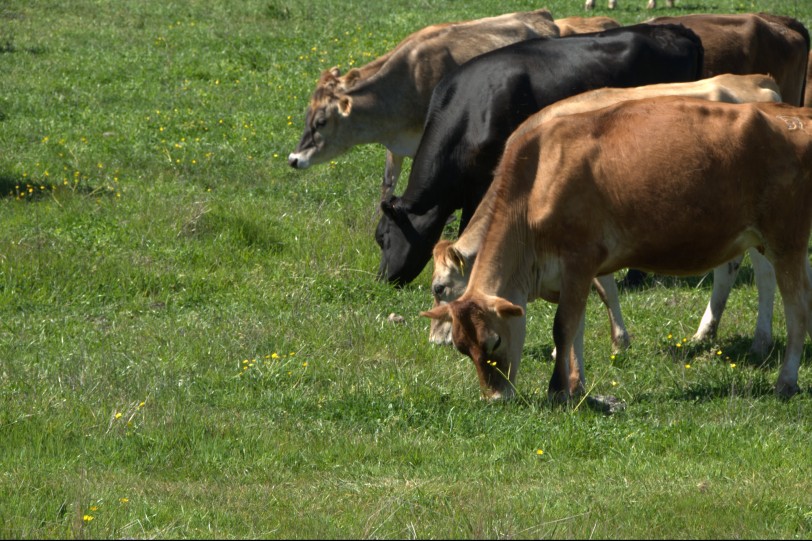
All grasses, annual and perennial, need herbivores of some sort to maintain them in a vigorous state. Unlike other plants and trees, grasses do not produce abscisic acid, the plant hormone that causes a plant to drop its old, worn-out leaves. Cattle, rodents, and insects carry out that mission for the grasses, but cattle do it on a large and fast scale. In fact, grasses evolved to be maintained by large grazing animals, which keep the grass healthy by removing its old leaves but also removing some of the fresher leaves to maintain itself. Through the digestive process, ruminant grazers like cattle introduce important bacteria to the masticated grasses, and through defecation, inoculate the soil with these same bacteria. Bacteria defecated by cattle turn the grasses into fine particulate matter that contributes to the organic matter in the soil, forming an important component of topsoil.